
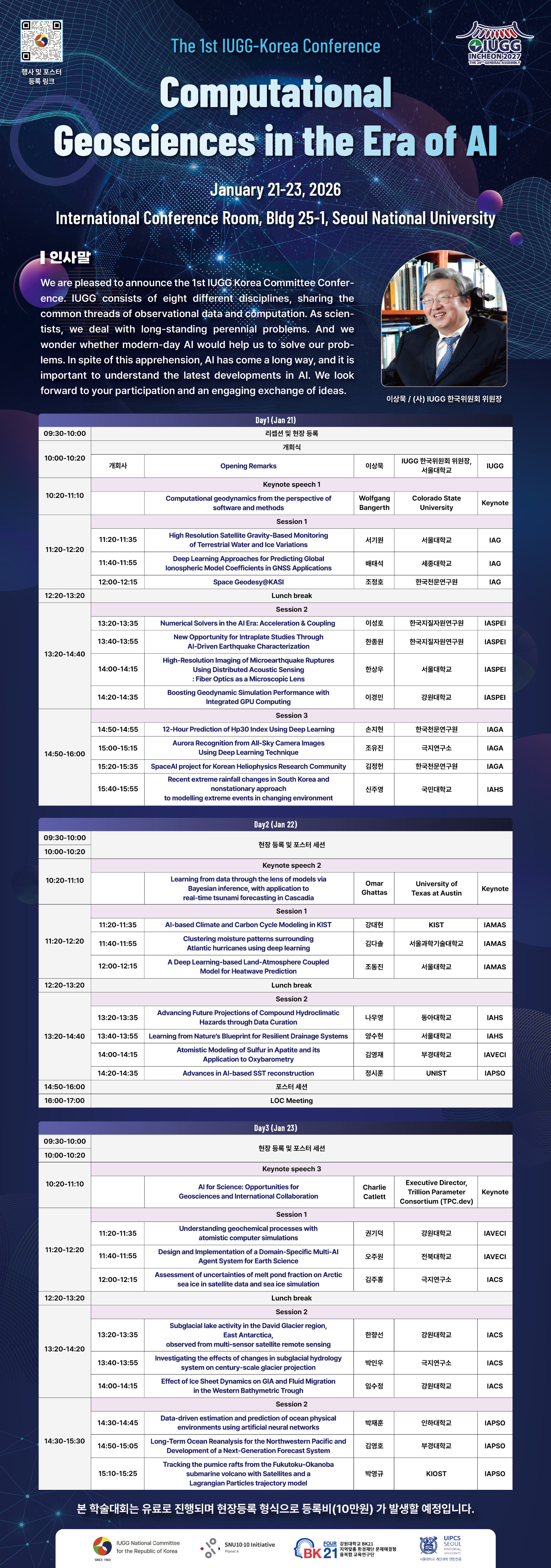
09:30 – 10:30
Reception & On-site Registration
10:00 – 10:20
Opening Remarks
Prof. Sang-Mook Lee
IUGG-Korea Chair, Seoul National University
10:20 – 11:10
Keynote Speech
Computational geodynamics from the perspective of software and methods
Prof. Wolfgang Bangerth
Colorado State University
Session 1
11:20 – 11:35
High Resolution Satellite Gravity-Based Monitoring of Terrestrial Water and Ice Variations
서기원 (서울대학교, IAG)
11:40 – 11:55
Deep Learning Approaches for Predicting Global Ionospheric Model Coefficients in GNSS Applications
배태석 (세종대학교, IAG)
12:00 – 12:15
Space Geodesy@KASI
조정호 (한국천문연구원, IAG)
12:20 – 13:20
Lunch Break
Session 2
13:20 – 13:35
Numerical Solvers in the AI Era: Acceleration & Coupling
이성호 (한국지질자원연구원, IASPEI)
13:40 – 13:55
New Opportunity for Intraplate Studies Through AI-Driven Earthquake Characterization
한종원 (한국지질자원연구원, IASPEI)
14:00 – 14:15
High-Resolution Imaging of Microearthquake Ruptures Using Distributed Acoustic Sensing: Fiber Optics as a Microscopic Lens
한상우 (서울대학교, IASPEI)
14:20 – 14:35
Boosting Geodynamic Simulation Performance with Integrated GPU Computing
이경민 (강원대학교, IASPEI)
Session 3
14:30 – 14:45
12-Hour Prediction of Hp30 Index Using Deep Learning
손지현 (한국천문연구원, IAGA)
14:50 – 15:05
Aurora Recognition from All-Sky Camera Images Using Deep Learning Technique
조유진 (극지연구소, IAGA)
15:10 – 15:25
SpaceAI project for Korean Heliophysics Research Community
김정헌 (한국천문연구원, IAGA)
15:30 – 15:45
Recent extreme rainfall changes in South Korea and nonstationary approach to modelling extreme events in changing environment
신주영 (국민대학교, IAHS)